
Disaggregated Network
Direct sorting and injection bypass multiple transit nodes, reducing parcel handling damage and shortening transit duration down to same-day/next-day turnaround cycles.
Step into India's fastest-growing last-mile logistics ecosystem. Secure exclusive territory pin codes, leverage centralized volume allocations, and build a recurring cash-flow operation with state-of-the-art tech support.
Strategic Logistics Landscape
Analyzing India’s decentralized supply chain transformation and why micro-entrepreneurs hold the competitive advantage in hyper-local distribution.
The landscape of Indian e-commerce fulfillment has undergone a foundational paradigm shift. In earlier iterations of the logistics market, centralized national conglomerates managed fulfillment via heavy hub-and-spoke frameworks that resulted in elevated middle-mile expenses, fragile delivery SLAs, and excessive Return-to-Origin (RTO) rates. Valmo has disrupted this paradigm by building a technology-first, disaggregated logistics ecosystem designed to empower localized micro-entrepreneurs.
Operating a Valmo franchise provides direct access to high-velocity shipping lanes fueled by major e-commerce marketplaces, D2C native brands, and regional sellers. Instead of spending months acquiring individual merchant clients, a Valmo franchisee functions as the designated distribution node for an allocated pin code or sector. Inbound shipments arrive pre-manifested from regional line-haul hubs directly to your local facility every morning, providing consistent daily operational volume from day one.
Direct sorting and injection bypass multiple transit nodes, reducing parcel handling damage and shortening transit duration down to same-day/next-day turnaround cycles.
Benefit from pre-routed commercial deliveries channeled from high-frequency categories including apparel, consumer electronics, beauty, and domestic goods.
Transparent commission accounting based on successful First-Attempt Deliveries (FAD), pickup originations, and real-time COD reconciliation cycle timelines.
Financial Due Diligence
Transparent capital expenditure (CAPEX) and recurring operating expense (OPEX) requirements for standard Tier-1, Tier-2, and Tier-3 operations.
Starting a delivery franchise requires disciplined capital allocation. Unlike retail franchises that demand heavy interior renovation and expensive upfront franchise license fees, a logistics branch is purely functional. Investment capital is directed strictly into productive operational infrastructure: storage security, barcode telemetry, sorting layout, and rolling liquidity.
| Expense Category | Description & Specific Requirements | Type | Estimated Cost (INR) |
|---|---|---|---|
| Hub Space Rental Advance | 250–500 sq.ft. commercial ground floor facility (2–3 months security deposit) | CAPEX | ₹25,000 – ₹50,000 |
| Hardware & Scanning Tech | 2D Barcode Scanners, thermal receipt printers, electronic digital scale (up to 50kg) | CAPEX | ₹18,000 – ₹28,000 |
| Facility Security & Safety | 4-Channel HD IP CCTV kit (30-day continuous cloud/DVR recording), fire extinguishers | CAPEX | ₹14,000 – ₹22,000 |
| Furniture, Racks & Bins | Heavy-duty metal slotted angle racks, pigeon-hole sorting bins, receipt packing counter | CAPEX | ₹15,000 – ₹25,000 |
| Refundable Security Deposit | Reversible operational caution deposit credited to logistics network administration | CAPEX | ₹25,000 – ₹50,000 |
| Working Capital Reserves | Cash buffer to cover initial fuel allowances, vehicle maintenance, and rider payouts | OPEX | ₹40,000 – ₹70,000 |
| Inverter / Power Backup | 1 KVA sine-wave inverter + battery ensuring zero downtime during parcel dispatches | Optional | ₹12,000 – ₹18,000 |
| Total Initial Estimated Setup Capital | ₹1,49,000 – ₹2,63,000 | ||
*Note on Land Lease: Real estate rentals vary significantly between metropolitan commercial catchments and semi-urban tier-3 centers. Facilities located near major arterial bypasses or secondary roads minimize rental burn while providing heavy vehicle ingress for early morning line-haul arrivals.
Unit Economics & Financial Modeling
Real-world volume projections illustrating revenue scale as parcel handling throughput increases.
A logistics hub's gross profitability is a direct function of parcel density per square kilometer. As route density compounds within an assigned pincode, rider efficiency doubles—lowering the effective delivery cost per unit and widening the franchise partner's operating margin.
Based on standard delivery remuneration (₹14–₹18 per delivered shipment) + pickup incentives.
Operating costs scale predictably: 3 dedicated delivery riders equipped with two-wheelers can comfortably disburse 70–90 parcels each per day in compact urban sectors. Subtracting rider compensation, fuel provisions, rent, and minor utilities, an active partner typically generates a steady net margin between 22% to 34% once daily parcel throughput stabilizes beyond 250 units.
Facility Architecture
Mandatory standards required for passing site inspection prior to territory activation.
Execution Playbook
The daily cycle that maintains 98%+ SLA performance from line-haul arrival to evening cash reconciliation.
Commercial line-haul trucks arrive from regional mother hubs. Seal numbers are verified, and tamper-evident transit bags are scanned into the WMS system.
Individual parcels are scanned at the piece level, checked for damage, and segregated into localized delivery beats (ward-wise clusters).
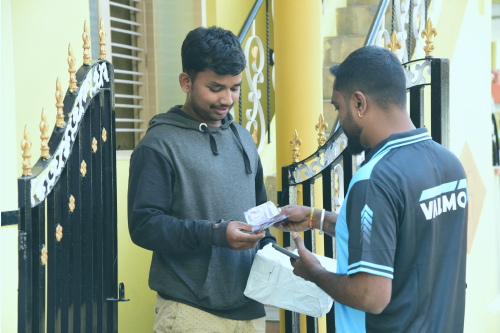
Delivery associates scan assigned shipments into their mobile app, confirm OTP/run-sheets, load delivery crates, and depart for their designated sectors.
Associates return to the hub. Undelivered packages are verified with digital non-delivery reasons, customer OTPs logged, and Cash-on-Delivery (COD) cash is balanced to the rupee.
Because Cash-on-Delivery remains a key payment method in Indian e-commerce, strict financial discipline is vital. Valmo's software architecture enforces instant daily closing reconciliations.
Collected cash is matched directly against parcel status logs. Funds are either deposited into the designated company bank portal via CDM (Cash Deposit Machines) or processed through digital UPI payment handshakes. This zero-leakage workflow guarantees total accountability for franchise owners.
Legal & Compliance
Understanding exclusive distribution agreements, licensing requirements, and risk mitigation strategies.
Before an applicant can be granted an operating license and franchise agreement, the applicant must clear the standard enterprise compliance desk:
To avoid internal network cannibalization, Valmo allots territories on a structured pin-code or micro-catchment boundary basis. Once your hub is commissioned and reaches agreed operational capacity, neighboring hubs are strictly restricted from servicing your mapped addresses. This ensures long-term business security and sustainable profit margins for dedicated franchise operators.
Operational Readiness
Navigating seasonal peaks, rider turnover, transit shrinkage, and RTO control with proven operational protocols.
The Risk: Delivery riders leaving without notice can create route logjams during high-volume periods.
Mitigation: Maintain an active waitlist of local gig workers and cross-train in-hub sorting staff to handle reserve delivery routes when volume surges occur.
The Risk: High customer rejections and fake non-delivery scans directly diminish franchisee profitability.
Mitigation: Implement automated IVR call audits and mandate geofenced app scans so shipments can only be marked as attempted when the rider is physically at the customer's coordinates.
The Risk: Lost or damaged high-value merchandise leads to carrier debits and inventory penalties.
Mitigation: Enforce strict inbound scale audits, monitor high-risk shipments under dedicated CCTV view, and conduct mandatory staff bag checks at shifts end.
Clarifications & Guidance
Common questions answered regarding operational terms, capital requirements, and profitability.
Valmo's central routing engine integrates with major online marketplaces and merchant order systems. When a customer inside your registered pin code completes a checkout, the parcel is automatically designated for delivery by your hub during morning transit routing.
While prior logistics background in companies like Delhivery, Shadowfax, or Ekart is advantageous, it is not mandatory. We look for proactive entrepreneurs with strong local geographical knowledge, leadership skills to manage a delivery crew, and basic computer proficiency.
The standard onboarding timeline takes approximately 10 to 18 business days. This includes desk application screening (24–48 hours), field site verification, legal agreement signing, equipment procurement, and software training for you and your staff.
Delivery associates are engaged directly by your franchise entity as contracted delivery partners or on-roll staff, typically compensated via a hybrid model of base daily pay plus per-successful-delivery incentives and fuel allowances.
Yes. Once your primary hub maintains high SLA performance (95%+ successful first-attempt deliveries) for 90 days, you become eligible to apply for adjacent pin codes under a cluster hub agreement.
Reverse logistics are picked up by your riders during standard delivery runs. Each verified reverse pickup earns a flat pickup commission, providing an additional source of revenue alongside forward dispatches.